
Disguised Alpha   /   Compound references. Original research.
BromantaneResearch reference

Adamantane derivative / Neurobiology

BromantaneUnderstand the research.

Bromantane, also spelled bromantan, is an adamantane-derived small molecule discussed in the scientific literature under the name Ladasten. Research includes rat neurochemistry, experimental synaptic plasticity, and Russian clinical studies of asthenic disorders. These studies address specific experimental or clinical settings. They do not establish a universal effect on focus, motivation, or performance, and short observations cannot determine long-term safety.

Limited human studies; preclinical mechanisms

A focused reference from the Disguised Alpha research network.

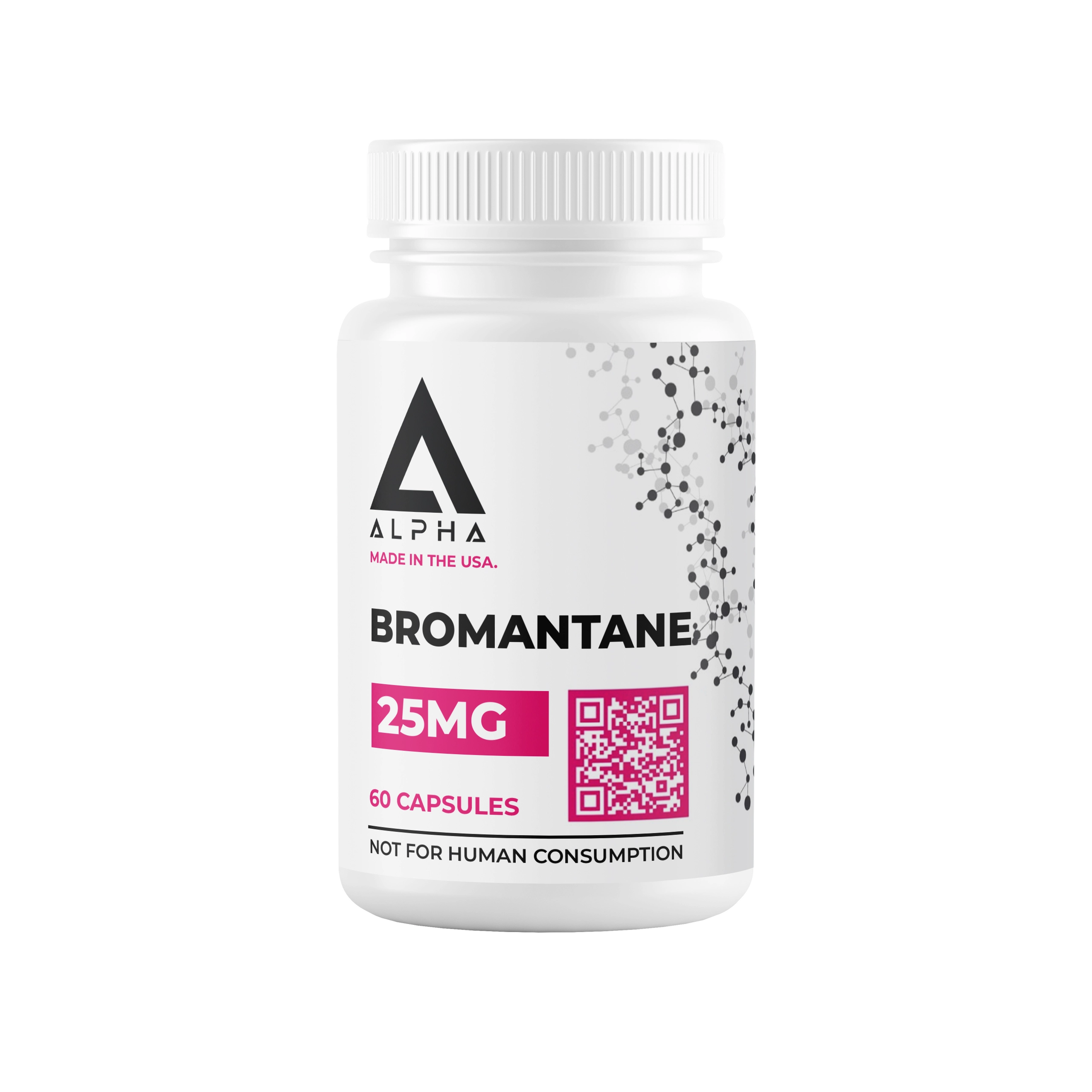
Disguised Alpha Bromantane product reference image
BromantaneCatalog imagery · RUO
Molecular formula
C₁₆H₂₀BrN
Molecular weight
306.24 g/mol
CAS number
87913-26-6

Disguised Alpha catalog

Find the matching product.

Open the exact product listing for its format and documentation. Published studies do not validate a supplier’s finished product.

01 / The science

Understand the research focus.

A clear starting point for the mechanisms, experimental models and questions behind the compound.

01

Catecholamine synthesis

A rat study measured region-dependent changes in tyrosine hydroxylase, an enzyme involved in catecholamine synthesis, alongside dopamine and L-DOPA. The pattern was not a simple uniform increase throughout the brain. This distinction matters when interpreting simplified claims that bromantane merely “boosts dopamine.”

Read the primary source ↗
02

Dopamine-related pharmacology

Experiments in rat brain preparations examined synthesis, release, uptake, and receptor activity separately. Investigators reported effects on dopamine synthesis and transport but no direct activity at the tested dopamine and serotonin receptors. These assays describe different processes and should not be treated as interchangeable mechanisms.

Read the primary source ↗
03

Asthenia research

Published clinical work includes a blinded placebo comparison and a larger multicenter treatment study. Symptom-rating changes provide a clinical research signal, but interpretation depends on the presence of a comparator and the studied diagnosis. The evidence cannot automatically be transferred to healthy people or to another product format.

Read the primary source ↗

02 / Read with context

Know what the evidence can tell you.

The selected research applies to the tested molecule, experimental model and conditions. It does not establish equivalent effects for a commercial formulation or support assumptions about clinical benefit or long-term safety.

Start with three questions.
01What was tested?
Check the exact molecule, sequence, composition and formulation.
02Where was it tested?
Cells, animals and clinical populations answer different questions.
03What was measured?
A pathway signal is different from a demonstrated clinical outcome.

03 / Selected publications

Go straight to the source.

Original records, study models and the limits that matter when interpreting a result.

STUDY 01 · 2007
Rats and isolated hippocampal preparations

The effects of ladasten on dopaminergic neurotransmission and hippocampal synaptic plasticity in rats

The study linked region-specific neurochemical changes with reinforcement of synaptic potentiation in vitro. Blocking protein synthesis prevented that reinforcement; interfering with D1/D5 signaling attenuated it.

Reading limit: These results support a mechanistic hypothesis. They do not demonstrate improved human learning or characterize the effects of long-term exposure.

↗
STUDY 02 · 2009
Randomized, blinded clinical study in neurasthenia

Ladasten in neurasthenia: a placebo-controlled clinical study

The report described greater improvement in asthenic symptoms with Ladasten than placebo during a 28-day treatment period. A subsequent one-week placebo period was used to look for discontinuation symptoms.

Reading limit: The English abstract provides limited methodological detail. A brief withdrawal observation cannot establish absence of dependence risk across longer or different patterns of exposure.

↗
STUDY 03 · 2010
Multicenter clinical treatment study; 728 analyzed patients

Treatment of asthenic disorders in patients with psychoautonomic syndrome: results of a multicenter study on efficacy and safety of ladasten

Investigators reported improvements in symptom scales over 28 days and follow-up, with adverse events also recorded. The study offers information about the observed patient group.

Reading limit: The abstract describes no placebo comparison. Changes cannot be cleanly separated from expectation, natural fluctuation, or other contextual influences.

↗

A focused selection, not a systematic review. Studies concern the tested material and do not validate a supplier’s finished product.

Explore research & source notes →

04 / Common questions

A little more clarity.

Quick answers for reading the science behind Bromantane.

Are bromantane and Ladasten related names?

Yes. Ladasten is a name used in the cited bromantane literature and chemical identity records. A shared ingredient name does not establish equivalence between all commercial preparations.

Is it a direct dopamine receptor agonist?

The cited rat assays found no direct effect at D1, D2, or D3 receptors. Researchers instead investigated synthesis, release, and transport. This is a specific laboratory finding, not a complete human mechanism.

Does the clinical literature prove a benefit for healthy users?

No. Studies in people with neurasthenia or asthenic disorders answer a different question. Their outcomes cannot be assumed to apply to healthy populations seeking better focus or endurance.

What remains uncertain?

The reviewed papers do not settle long-term safety, broad population effectiveness, or equivalence between alternative formulations. Readers should distinguish measured outcomes from authors’ hypotheses and general marketing claims.

Continue your research

One compound. A wider research library.

Explore the complete Bromantane profile and related compounds in the Disguised Peptides research hub.

Open the full profile ↗